Meta has launched Creator Fast Track
Meta’s Creator Fast Track programme guarantees three months of pay for established creators willing to build a following on Facebook, after the company paid out a record $3 billion to creators in 2025.
Facebook has a creator problem that three billion monthly users cannot solve. The platform is enormous, but the creators who drive the short-form video economy, the ones building loyal audiences on TikTok and YouTube, have largely looked past it.
Starting on a new platform from zero is daunting, and Facebook’s history with creators has been complicated enough that even those who’ve heard the pitch have reason to hesitate.
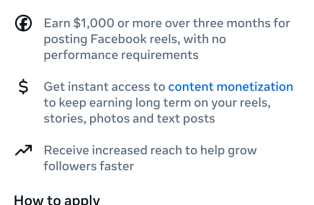
On Wednesday, Meta launched Creator Fast Track, a direct attempt to address that hesitation with cash. The programme offers established creators with audiences on other platforms guaranteed monthly payments for three months in exchange for posting Reels on Facebook.
Creators with at least 100,000 followers on Instagram, TikTok, or YouTube can earn $1,000 per month; those who have crossed one million followers on any of those platforms get $3,000 per month.
The eligibility requirements are not onerous. Creators need to post at least 15 Reels on Facebook within a 30-day period, spread across at least 10 different days. The content does not need to be Facebook-exclusive and can include AI-generated material, as long as it is original to the creator.
Participation also unlocks immediate access to Facebook Content Monetization, the broader invite-only programme that pays based on content performance, which means earnings continue even after the three-month guaranteed period ends.
The programme lands alongside a figure Meta is clearly pleased with: in 2025, Facebook paid content creators nearly $3 billion through its monetisation programmes, a 35% increase from the previous year and its highest annual payout on record.
That compares with $2 billion in 2024, a figure Rest of World independently confirmed in February. The number of creators earning more than $10,000 annually on Facebook grew by over 30% year-on-year.
The breakdown of where that money went is also notable.
Sixty per cent of the $3 billion went to Reels, while the remaining 40% was split across Stories, photos, and text posts. That last detail matters for the Creator Fast Track pitch: unlike TikTok and YouTube, which are fundamentally video-first platforms, Facebook Content Monetisation pays for almost everything a creator posts.
A writer who shares text posts, a photographer posting stills, or a creator who mainly works in Stories can all earn from the platform without committing to video production.
Facebook Content Monetisation itself has expanded dramatically over the past year. According to Rest of World’s analysis of data from the Meta Monetisation Archive in February 2026, the programme grew from roughly 2.7 million participants to 12 million in just over a year, with Indonesian-language accounts representing the second-largest cohort after English.
The global scale of that expansion is part of what makes the $3 billion figure credible, and part of what Facebook is hoping to leverage to attract creators who might otherwise dismiss the platform as irrelevant to younger audiences.
Meta is also introducing new metrics alongside the programme to help creators understand their earnings more precisely.
These include a Qualified View metric, views on content eligible to earn money, an Earnings Rate showing approximate pay per 1,000 qualified views, and a Non-Qualified Views breakdown explaining why certain views do not generate revenue.
The clearer feedback loop is designed to help creators optimise their content performance rather than simply guessing why their payouts vary.
The strategic logic of Creator Fast Track is not subtle. Facebook has been pushing Reels hard since 2020, positioning them as its response to TikTok’s dominance in short-form video.
But Reels require content, and content requires creators willing to invest the time to build on the platform. The guaranteed payment model removes the risk that typically stops established creators from experimenting with a new home: the fear of posting consistently for months and earning almost nothing while an audience is still being built.
For Meta, which reported advertising revenue of roughly $160 billion in 2025, writing cheques to a few thousand established creators is a rounding error against the potential payoff of a more creator-rich Facebook feed.
Whether creators bite depends on something harder to measure than the cash: whether Facebook’s audience and long-term monetisation potential are worth the effort of maintaining yet another profile.
The $1,000-a-month tier, which requires 100,000 followers to qualify, is not a transformative sum for a creator at that scale. The $3,000-a-month tier is more meaningful, though most creators at the million-follower level will be weighing it against what they already earn.
What the programme does offer, unambiguously, is a no-downside trial run, three months of guaranteed income to find out whether Facebook’s reach can surprise them.