TikTok Affiliate Marketing: How To Get Started (2026)
TikTok affiliate marketing lets your business tap into the power of creator collaborations—at a price that works for your budget. Most paid marketing strategies require businesses to pay upfront for an advertising plan they hope will generate a return. Even cost-per-click advertising is a risk; you might end up paying for clicks that ultimately don’t result in sales.
TikTok affiliate marketing is a rare exception. Because payouts are tied to sales, well-run affiliate programs rarely lose money, and programs that don’t generate any sales end up being free (or close to it).
Affiliate programs allow brands to access the relationship-building and niche targeting power of influencer marketing strategies with minimal financial risk. They also allow creators to monetize their followings and add a relatively passive revenue stream when viewers buy products they’ve recommended.
Here’s how TikTok affiliate marketing works—and how both brands and creators can leverage this strategy to make money through the app.
What is affiliate marketing?
Affiliate marketing is a model of partnership between a brand and a creator who promotes the brand’s products or services. Creators promote products to their followers via social media, blogging, email, and other channels. Each time someone completes a purchase through that creator’s promotional links, the brand pays the creator a predetermined commission.
The model includes three main parties—sellers (also known as brands), creators (also known as affiliates), and viewers (also called buyers)—and is a popular way for retailers to market their products. Brands pay commission only when their affiliates sell products on TikTok—unlike traditional influencer marketing, where you pay a set fee upfront regardless of how many sales the influencer drives.
Here’s how the affiliate marketing model works in more detail:
1. Brands distribute custom affiliate links to creators
Each creator (or affiliate) receives a custom affiliate link or dedicated affiliate URL that identifies it as the creator’s. In some cases, brands attach a coupon code or other discount code to the affiliate link.
2. Creators promote brands via product affiliate link
Creators incorporate affiliate links into their social media accounts, personal websites, or other marketing channels and encourage their audiences to make purchases via their links. Some creators also use paid advertising tactics to increase reach and encourage engagement with affiliate offers.
3. Brands pay creators for purchases
When a customer uses the creator’s link to make a purchase, the brand pays the creator a commission. In some cases, a third party known as an affiliate network functions as the middleman between the brand and the creator. These services can help brands and creators find each other, and streamline the process of making and receiving commission payouts.
How does TikTok affiliate marketing work?
Like other affiliate marketing programs, TikTok affiliate marketing can help retailers increase brand awareness and reach specific target audiences. It is a key part of many brands’ TikTok marketing strategy.
Although TikTok users can’t add clickable links to videos, any user with a TikTok business account can use their TikTok profile pages to link directly to an affiliate offer. You can also redirect traffic to profiles on more link-friendly social media platforms.
Creators can also upload TikTok videos that direct viewers to dedicated URLs, and promote discount codes in video captions. Paid TikTok advertising can also be used to increase reach, encourage click-throughs, and boost commission income.
Users with more than 10,000 followers can add clickable links to TikTok Stories—short videos on an account’s profile page that disappear after 24 hours.
TikTok is different from other social media platforms in the sense that creators can tag products from their affiliate partner’s TikTok Shop. Users can view your video and click through to see full product details, then purchase the affiliate products you’ve recommended. They can do all of this seamlessly, without leaving the app or relying on third-party cookies, when they head to the brand’s website.
TikTok Shop affiliate program: What you need to know
Selling on social has become standard and beneficial for many brands. TikTok has put requirements in place for who can sell, what they can sell, and how they get paid.
Before you start building your TikTok affiliate marketing strategy, know these rules of engagement.
Eligibility requirements for TikTok Shop affiliates
To get your foot in the door for the US program as a TikTok Shop affiliate, you must meet these requirements:
- Be at least 18 years old
- Be based in the United States
- Pass a mandatory identity and address verification
- Have a clean record with no prior revocations of TikTok Shop permissions
Your follower count determines how you enter the program.
- Affiliate Creator. You must have at least 1,000 followers to self-apply.
- Marketing Creator. If you are linked directly to a specific seller account (Official Shop Creator), the 5,000-follower minimum applies to access the Product Marketplace.
- Official Shop Creator. If you are the official voice of a specific shop (sharing the same account name), there is no follower minimum, but you are restricted to promoting only that shop’s products.
If you have between 1,000 and 5,000 followers, you aren’t fully unleashed yet. You’ll be automatically placed in a 30-day Creator Pilot Program.
- Restrictions: You’ll have limits on the number of shoppable videos and Lives you can publish daily, and you won’t be eligible for campaigns. You’ll also be limited to promoting products from brands with a TikTok Shop Performance Score of over 95%.
- Graduation: To exit the pilot, you must hit specific performance benchmarks, such as maintaining a high Creator Health Rating or generating a set number of orders.
💡Note: TikTok Shop’s affiliate program is available in other countries including the United Kingdom, Spain, and Singapore. Requirements vary by region.
Commission rates and payment structure
TikTok Shop affiliate marketing is strictly commission-based. The seller, not the platform, sets commissions.
While rates vary based on margins, here’s what’s typical in the market:
- Physical goods: 5% to 15% (fashion, beauty, gadgets).
- Digital goods: 20% to 30% (software, courses).
To protect creators from bait-and-switch tactics, TikTok enforces a 30-day commission lock.
- Rate increases. If a seller raises the commission, you get the raise immediately.
- Rate decreases. If a seller drops the rate, your original (higher) rate is locked for 30 days. You also receive a two-day advance notice before the drop takes effect.
If you delete your promotional content or remove the product from your showcase, you lose the locked rate.
💡Note: While TikTok provides creator protections around commission changes, policies may evolve. Verify current terms via TikTok Seller University (or official documentation) before you commit to any affiliate partnerships.
Payout timing
Payouts are calculated as (Revenue – Refunds) x Commission Rate.
- The window. Commissions are typically paid out roughly 15 days after the order is delivered.
- Refunds. If a customer returns the item, your commission is deducted. If it’s a full refund, the commission becomes zero.
- Delays. Timelines can extend if there are customer disputes or if the seller has a longer settlement period (for example, delivery plus 31 days).
Product categories and restrictions
Not everything can be sold on TikTok Shop. The platform distinguishes between items that are banned outright and those that require extra paperwork.
Prohibited products
The following items are completely off-limits. Listing them will get you banned.
- Adult products and sexual content
- Alcohol, tobacco, and e-cigarettes
- Weapons, ammunition, and hazardous materials
- Vitamins and supplements for children aged under three
- Unlicensed medicines
- Beauty products made from or containing CBD
Restricted products
You can sell restricted products, but the seller must provide documentation—such as safety certifications or brand authorizations—before the listing goes live.
Common restricted categories include:
- Baby and maternity products
- Beauty and personal care
- Electronics
- Food, beverages, and supplements
- Pet supplies
Ways to make money with TikTok affiliate marketing
With TikTok’s massive base of users and an engagement rate of 27.6% (double that of Instagram), there’s a sizable opportunity for creators and brands interested in affiliate marketing on the platform. The right combination of content creation, audience targeting, and performance tracking can drive revenue for your brand—whether you’re selling handbags or headphones.
With TikTok’s algorithm-driven content discovery, affiliate marketers have a unique opportunity to reach new audiences organically.
It’s a particularly effective money-making strategy for affiliates who sell trendy or high consideration products. You can create video content that relies on capturing attention and building trust quickly, then direct viewers to your brand’s TikTok Shop to purchase immediately.
On the paid side, TikTok has a growing advertising infrastructure that brands and creators can experiment with, too. With an understanding of TikTok’s ecosystem and an eye on user behavior patterns and current trends, the risks are low and the upside is enormous.
Use organic traffic
With more than 1.99 billion monthly active users, your affiliate products can reach a broad and highly engaged TikTok audience.
Unlike other platforms that rely heavily on surfacing content related to a user’s network of connections, the For You page surfaces targeted and entertaining content for users based on their interactions with content.
This unique attribute of the TikTok algorithm levels the playing field for creators and brands of all sizes. It means users are almost equally likely to encounter content from major TikTok influencers with millions of followers as they are to see TikTok videos from smaller accounts.
Of course, the potential of TikTok affiliate marketing needs to be paired with practical execution. Your vertical videos need to capture attention within the first few seconds and deliver value quickly to prevent users from scrolling past it. Incorporating popular sounds, hashtags, and challenges are all ways to boost organic reach.
Once you capture that attention and traffic, here’s how to leverage it to drive affiliate purchases:
- Use strategic affiliate link placement on TikTok. Add TikTok affiliate links to the video description of a post, the first comment of a video, and the link in your TikTok profile. You can use link-shortening services like Bitly or TinyURL to track click-through rates and conversions from specific TikTok videos.
- Use a link-in-bio tool. Linktree and Bitly allow creators to consolidate multiple TikTok affiliate links in one accessible location. This circumvents the platform’s single bio link limitation and is useful on other social networks as well.
- Share promo codes with your audience. Brands provide unique coupon codes to TikTok creators (e.g., “Krista20”), who then share these coupon codes with their audience in TikTok videos. You can integrate a coupon code into a TikTok video by displaying it on-screen, mentioning it in your voice-over, or including it in the video caption.
- Create a multiplatform funnel. Creators can drive traffic from TikTok to their website or other platforms like Instagram or YouTube, where they can provide product information and multiple affiliate link touchpoints. For example, a beauty influencer might use TikTok to tease 30-second makeup looks, directing viewers to YouTube for full tutorials and affiliate product links.
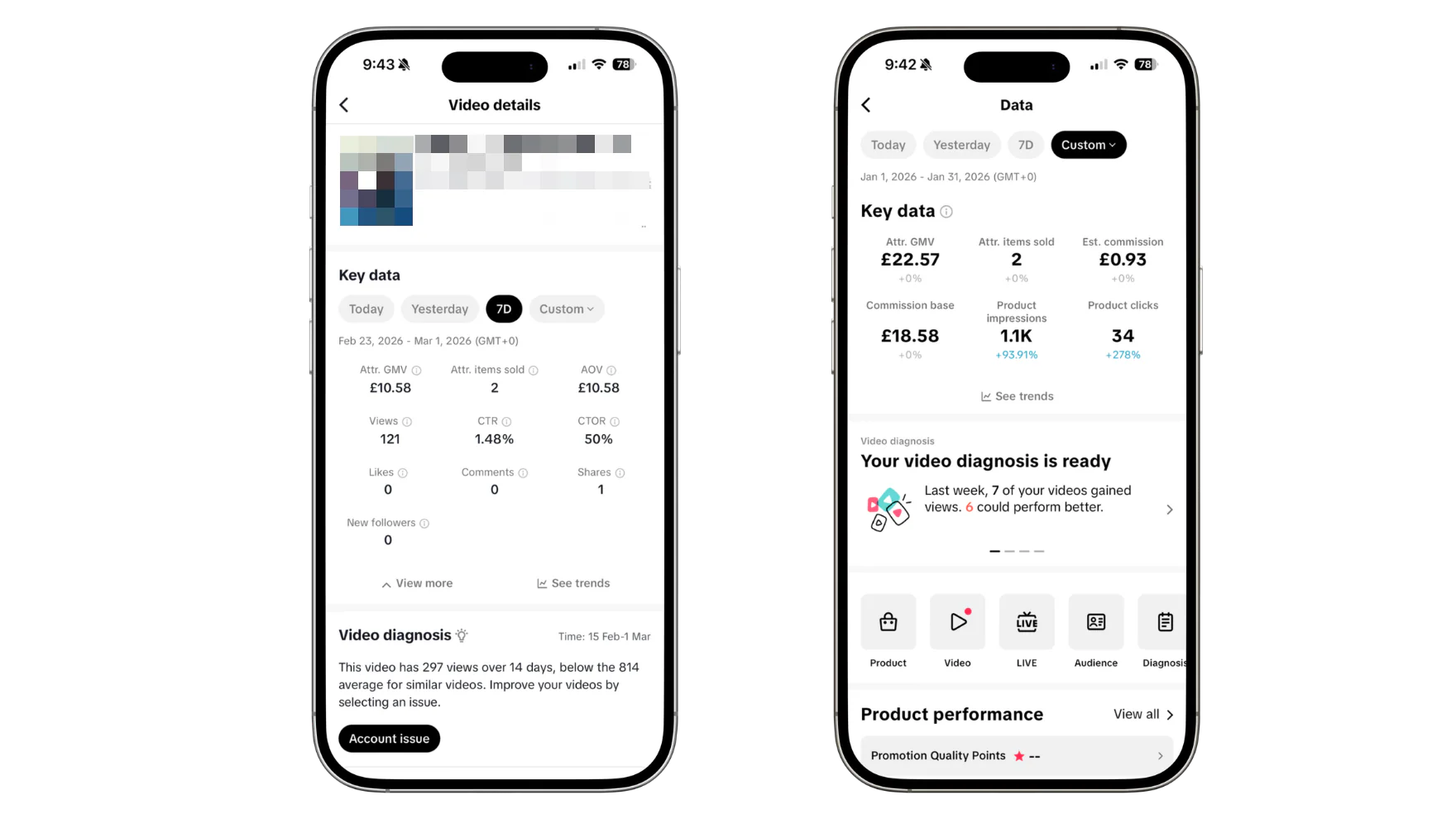
Use TikTok’s analytics tool to monitor how many clicks your TikTok Shop affiliate links get, including the percentage of people who view your affiliate content and click to view more (click-through rate, or CTR). Is a particular product more popular than others?
If you’re linking directly to a brand’s website, use analytics tools—like those provided by link-in-bio platforms—to detect differences in CTRs. Are people more likely to click from an unboxing video? A link in your TikTok Story?
Lean into insights to guide your future affiliate link strategy. If you notice that links in your Story have a high click-through rate, for instance, cross-post every video to the same placement with a link to shop.

Use TikTok paid advertising
TikTok offers a range of ad formats, including In-Feed Ads, TopView, Branded Mission, Spark Ads, and TikTok Promote. These ads take advantage of TikTok’s powerful targeting capabilities, including interest-based, behavioral, and demographic targeting.
Unfortunately, TikTok’s advertising costs can be challenging for small brands and individual affiliates. Minimum daily campaign spends start at $20 to $30 and cost per mile (CPM) rates typically start at $10, higher than platforms like Facebook or Instagram.
To navigate this, smaller brands and creators can focus on expanding organic reach first, then reinvesting any profits into paid campaigns. Try TikTok’s lower-cost options like In-Feed Ads or partner with nano-influencers for Spark Ads, which amplify high-performing organic content.
“Creators can also collaborate with brands by providing a Spark Ad code, giving the brand permission to use their video in TikTok ads,” says influencer and affiliate marketing consultant Viviana Viale. “The creator will still receive a commission for each sale generated through TikTok Shop. This is an excellent opportunity to work closely with brands, understand their goals, and tailor content to align with their marketing strategies.”
Let TikTok’s detailed analytics guide your content strategy and help you refine targeting to improve return on investment (ROI). Over time, this will make paid advertising more accessible as campaign efficiency increases.
Leverage TikTok Shop features
TikTok Shop offers a complete toolkit to turn engagement into revenue. Here are some ways to make money with it:
- Filter for winners in the Product Marketplace. Use the marketplace to filter products by commission rate, sales history, and store rating to find high-converting inventory.
- Curate an always-on Product Showcase. Build a digital storefront on your profile that acts as a central hub, so you can tag products in videos, LIVEs, and comments.
- Request free samples for authentic demos. Use the platform to request samples from sellers so you can demonstrate products in real-time during Live sessions without upfront costs.
- Accelerate creation with the Shoppable Video Hub. Use TikTok’s built-in templates and AI tools to produce high-converting shoppable content faster.
- Join affiliate campaigns. Qualify for special affiliate programs and collaborations to gain access to better commission rates and campaign-based traffic boosts.
- Scale based on TikTok Analytics. Monitor your Creator Center dashboards to identify winning formats and products, then double down on what drives gross merchandise value (GMV).
- Boost Shop Products with Shop Ads. Take your top-performing organic content and amplify it using TikTok Shop Ads (like Video Shopping Ads) to keep the checkout experience entirely in-app.
How to become a TikTok Shop affiliate
Becoming a TikTok affiliate marketer is a low-risk way to add a creator revenue stream to your portfolio. Once you’re up and running, it can also be a source of passive income. As long as your link remains live, you can make money from clicks and purchases.
Here’s how to get started as an affiliate marketer on the TikTok platform:
1. Define your niche
The first step is to define your niche, including the subjects you’ll cover and the needs and interests of your target audience.
If you have a sizable TikTok audience, you may already have an established focus. If not, consider what types of TikTok content you’d like to upload and what sort of product or marketing niches might be associated with your interests. For example, if you have expertise in fly fishing and camping, you could consider a niche in outdoor skills and gear.
2. Create a TikTok business account
In order to share all your affiliate links on your TikTok account, you’ll need to convert your personal TikTok account to a free TikTok business account.
Here’s how to make the switch to a TikTok business account:
- Open the TikTok app and click Profile.
- Select Menu, then Settings and Privacy.
- Select Manage account.
- Select Switch to Business Account.
3. Join affiliate marketing programs
The next step is to find affiliate marketing programs in your niche. You can sign up for an affiliate network, research individual companies on a directory like the Shopify affiliate program, or reach out to brands directly to learn if they have an affiliate program.
Creators can earn commissions through TikTok Shop by participating in the platform’s official creator marketplace or through direct partnerships with brands using the shop feature.
“In TikTok Shop, requesting a sample directly from brands is easy,” says Viviana. “I recommend messaging the brand through the TikTok Shop messaging system, explaining why they’ve requested the sample and how they plan to promote the product.”
4. Maintain open lines of communication with brands
When selecting affiliate partnerships, creators should prioritize brands and affiliate products that genuinely align with their content and audience values, as authenticity fosters trust and long-term success.
“Sometimes, a content creator might not like the product and may not want to create a video about it,” says Viviana. “In such cases, I recommend reaching out to the brand with honest feedback instead of ghosting or tagging products in livestreams without actually talking about them. It might seem like common sense, but creators who actively communicate with brands are a rare and valuable asset.”
5. Add affiliate URLs to your TikTok bio
Once you’ve identified affiliate programs, it’s time to start distributing your links. To add a link to your bio, click Edit profile and paste the relevant link. If you have multiple links, you can also create a landing page using a free link-in-bio tool like Linktree or Bitly to provide access to multiple URLs at once.
6. Create quality TikTok content
To maximize sales, create engaging videos that promote affiliate products and direct users to your unique affiliate links. You can also use relevant TikTok hashtags to boost organic traffic or invest in paid ads to reach a wider audience.
Experiment with different formats to see what gets the most views on your affiliate videos. Popular TikTok video ideas include:
- Trend-driven content
- Tutorials
- Unboxing videos
- Reviews
- Comparisons
- Hashtag challenges
- Duets and stitches
- Live shopping
- Product showcases
“Creators should promote products they genuinely use and believe in, as authenticity resonates with audiences and drives conversions. They can be as creative as they want, using engaging content formats such as tutorials, unboxings, reviews, or aesthetic content,” says Viviana. “Focus on demonstrating the benefits and unique features of the product in an entertaining and relatable way.”
As younger demographics can be more allergic to advertising, authenticity is key on TikTok. Viviana recommends taking a more organic approach to promotion. “Avoid using phrases like ‘I’ve been sent this product by TikTok Shop,’ as it can undermine the creator’s authenticity and the brand they are promoting,” she adds.
Allegra Shaw, of clothing brand Uncle Studios, says in a Shopify Masters interview, “I’m just always thinking about what do I want to see, what do I want to do, what feels good for me? Because I think that’s why people follow you, right? They follow you for you. You’re unique. You’re special. They like what you do. And so staying true to that is what is important to me.”
Examples of TikTok affiliate marketing
Affiliate marketing on TikTok offers brands an effective way to reach new audiences and for creators to earn income. Here are a few examples of how this affiliate marketing strategy can work in practice.
LTK Makeup by Shayla
Popular TikTok creator MakeupShayla uses LTK to monetize her fashion and beauty content. LTK is an affiliate marketing platform specifically designed for lifestyle influencers and content creators. Through LTK, Shayla curates shoppable collections of her outfits and beauty products, allowing followers to purchase individual items directly from her recommendations.
When viewers make a purchase using Shayla’s LTK links, she earns a commission on each sale. LTK acts as an intermediary platform, connecting creators like Shayla with brands, and enabling them to earn commissions on sales. Shayla’s LTK page is accessible via a Linktree link in her TikTok bio.

Good Protein
Canadian wellness brand Good Protein uses TikTok influencer affiliate marketing partnerships to promote its products that specialize in all-natural, plant-based superfood protein blends. The company collaborates with creators in the health and fitness niche, tapping into audiences already interested in nutrition and wellness.
One such partnership involved Jujeats, a micro-influencer with more than 4,000 followers, who integrated Good Protein’s product into a video showcasing a quick and healthy on-the-go snack. As part of this collaboration, Jujeats provided her followers with an exclusive discount code, JUJEATS, for 30% off Good Protein affiliate products, prominently displayed in her TikTok video’s description. This incentivized purchases and allowed Good Protein to track the success of the campaign.
Pinky and Kamal
Australian activewear brand Pinky and Kamal partnered with TikTok creator Dana Vaughan, who has more than 25,000 followers, to grow its brand among its target audience.
In a TikTok video of less than 60 seconds, Dana reviewed leggings from the brand’s Synergy collection, declaring them her favorite leggings ever worn. As part of this collaboration, Dana provided her followers with the discount code DANA15 to use on affiliate Pinky and Kamal purchases.
How sellers can offer affiliate marketing on TikTok
Unlike other types of creator marketing opportunities, offering your business’s own TikTok affiliate marketing program requires minimal upfront investment. Although you need to set up your own affiliate program, advertise it, and even approach individual creators, there’s limited financial risk. If a partnership doesn’t result in any sales, you won’t be responsible for paying out funds.
Here’s how sellers can start offering their own TikTok affiliate marketing program:
1. Develop affiliate offers
Identify your affiliate products—the products for which you’ll pay a commission on sale—and calculate the commission rates you can afford to pay creators.
Depending on your profit margins and marketing strategy, you might include affiliate links for your entire store or only for specific affiliate products. These might include items that generate larger profit margins, or products that you are specifically trying to promote.
Research how much competitors are awarding to affiliates to see the going rate in your industry. Your commission should be attractive enough to recruit quality creators while also preserving margins.
Tiered commission can work well here. It helps you recruit newer affiliates while giving them an extra incentive to continue promoting your products. You only pay out more commission to each affiliate when they hit a certain number of orders.
For example, you could offer:
- 5% commission for the affiliate’s first 10 orders
- 10% commission between 11 and 50 orders
- 20% commission on more than 51 orders
2. Set up your affiliate program
There are two ways to set up an affiliate marketing program: You can run your own affiliate program using an affiliate management app or affiliate marketing software, or you can join an affiliate network. Joining an affiliate network can minimize the workload associated with recruiting affiliates and running your program, but it also costs more. Networks typically charge a set-up fee and take a percentage of each affiliate sale.
“For clients new to affiliate marketing, I recommend joining an affiliate network or third-party service provider. These platforms provide access to a larger pool of affiliates and diverse business models,” says Viviana. “They simplify the process by handling tracking, reporting, and payments, significantly reducing administrative tasks for the brand.”
However, her advice differs for more established brands. “For more experienced businesses, a hybrid approach can be effective,” says Viviana. “Brands can initially leverage an affiliate network to scale quickly and then develop their own program for greater control, customization, and cost-effectiveness.”
To make your choice, consider whether or not you can afford to invest time in running an affiliate marketing business. If you’re considering an affiliate network, calculate how many sales you’d need to earn from the network per month to recoup your investment and estimate the likelihood of reaching that goal.
💡Tip: Shopify merchants have a direct path to sell on TikTok with the free TikTok app. It syncs your product catalog with TikTok Shop in real time for a seamless, hands-off approach. Any orders you make on the platform feed back to your Shopify admin for fulfillment as usual.
3. Recruit affiliate partners
If you’ve chosen to join an affiliate network, you can recruit affiliates through its platform. If you’re running your own affiliate program, you’ll need to do a little bit more legwork to find potential partners.
You can advertise your program on your company website, post about it on social media, or even send targeted messages to creators on TikTok. Look for creators who are popular with your target audiences, have brand identities that align with yours, and publish compelling content relevant to your affiliate products or services.
Viviana recommends taking a holistic approach when evaluating creator partnerships: “A creator’s engagement rate and average video views are more important than just a large follower count. TikTok Shop also offers an additional metric, the Video GPM (gross merchandise value) generated per 1,000 video views, which is a valuable indicator of a creator’s sales-driving potential.”
4. Manage your affiliates
Once you’ve recruited your affiliates, familiarize them with your brand, products, and program rules.
If your budget allows for it, you might also give affiliates sample products for use in their video content. You can also distribute an affiliate resource pack with product information, visual assets, and key marketing messages.
Encourage your affiliates to make high-quality content featuring your brand, as it can increase the likelihood that their videos will reinforce your company’s messaging.
“I also look at how frequently a creator posts on TikTok, the quality of their videos, and the number of other businesses they already collaborate with. Their content should align with the business’s image and values,” says Viviana. “Authenticity and a natural fit between the creator and the brand are crucial, as this translates into influence and sales potential.”
Pros and cons of TikTok affiliate marketing
TikTok offers a mix of advantages and challenges for brands and affiliate marketers. The platform’s explosive growth and engaged user base mean unprecedented opportunities, but they also come with specific hurdles.
Consider these pros and cons when crafting your TikTok affiliate marketing strategy:
Pros of TikTok affiliate marketing
- Algorithmic reach. TikTok’s content discovery algorithm allows for sizable organic growth without a large follower base. New affiliates can quickly reach the right audiences and gain traction with regular content creation.
- High engagement rates. TikTok boasts industry-leading engagement rates. This increases the likelihood of affiliate link clicks and conversions.
- Video-first format. TikTok’s short-form video format is ideal for product demonstrations and reviews, allowing creators to showcase affiliate products effectively. That might mean creating a quick unboxing sequence of the latest smartwatch, demonstrating a hair curler’s features in a 15-second clip, or showcasing a makeup before-and-after.
- Young, purchase-ready audience. TikTok’s user base is comprised largely of Gen Z and millennials. This user base is known for being willing to try new products and is often more receptive to influencer recommendations.
Cons of TikTok affiliate marketing
- Limited link placement. Unlike platforms like YouTube and Instagram, TikTok only allows one clickable link in user bios, with no in-video linking for most users. This restriction makes it challenging to direct viewers to specific affiliate products.
- Short content lifespan. The rapid pace of TikTok means content quickly becomes outdated, requiring constant new content to stay relevant as a creator or brand. This can be time-consuming and may limit the long-term value of individual pieces of content.
- Platform volatility. Compared to more established platforms, TikTok is relatively experimental. Users must navigate how to leverage TikTok features, trends, and algorithm changes, which can make it difficult to maintain consistent performance.
- Saturation in popular niches. Many product categories, especially in fashion, lifestyle, and beauty, are becoming oversaturated with affiliate content on TikTok. Standing out can be challenging and requires a strong product and thoughtful content strategy.
- Geographic limitations. TikTok is banned in some countries and has low adoption rates in others. It’s difficult (or impossible) to make money as an affiliate marketer on the platform if your target audience lives in these regions.
TikTok affiliate marketing FAQ
How can creators benefit from TikTok affiliate marketing?
TikTok affiliate marketing allows creators to earn commissions by promoting products and sharing affiliate links with their followers. Joining affiliate programs that align with your content can enhance earning potential. For instance, creating engaging videos that showcase products can attract attention, drive traffic, and ultimately result in sales through your unique links.
What is the standard eligibility for a TikTok affiliate?
Affiliate marketer eligibility is determined by the brand running the affiliate program, not by TikTok. Creators can consult individual brand websites to confirm their eligibility for any specific program.
What types of content work best for TikTok affiliate marketing?
Product tutorials, unboxing videos, and comparisons are popular amongst TikTok affiliates because they mirror organic content posted by other users. It appears less like an obvious advertisement and more like the content users are accustomed to seeing in their For You page.
Can multiple affiliate programs be promoted simultaneously on TikTok?
Yes. You can use a link-in-bio tool like Linktree to create a landing page that hosts multiple affiliate URLs at once.
How many followers are needed to be a TikTok Shop affiliate?
To participate as a TikTok Shop affiliate, creators must have a minimum of 1,000 followers, be at least 18 years old, and reside in the United States.