Strait of Hormuz remains shut as Trump pushes U.S. allies to help open the key waterway. Here’s what to know.
The Strait of Hormuz, the Persian Gulf waterway that serves as a key artery for global oil shipments, remains effectively closed as the Iran war continues.
The passage of oil tankers and other commercial ships has all but halted in the strait, sparking concerns that a prolonged conflict in the region could constrain global oil supplies, according to economists. Crude prices, which hovered below $70 per barrel in the days before the start of military operations on Feb. 28, have soared above $100 a barrel for the first time since 2022.
“The combination of an escalating conflict (including Israeli attacks on Iranian fuel depots), the ongoing disruption of Hormuz and announcements of producer shut-ins indicates the crisis is unlikely to be resolved any time soon,” energy analysts with Eurasia Group, a political risk consulting firm, said in a report earlier this month.
Here’s what to know about the Strait of Hormuz.
What is the Strait of Hormuz?
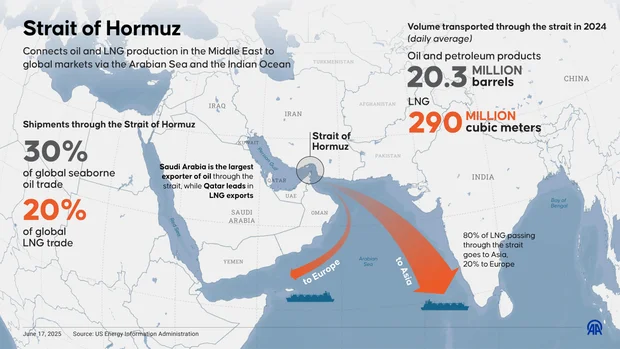
The strategic sea passage, located on Iran’s southern border, connects the Persian Gulf to the Gulf of Oman and the Arabian Sea. Long an important commercial trade route, the Strait of Hormuz ordinarily enables the flow of about 20% of global oil — roughly 15 million barrels of crude per day — along with liquefied natural gas shipments. Experts describe it as a strategic “choke-point” for crude.
Murat Usubali/Anadolu via Getty Images 
The strait — almost 100 miles long and roughly 21 miles wide at its narrowest point — allows the world’s largest vessels to transport oil and gas from the Middle East to China, Europe and the U.S. Most of that crude comes from Saudi Arabia, the United Arab Emirates, Iraq, Kuwait, Qatar and Iran.
What is happening in the Strait of Hormuz?
The Iran war has brought the passage of oil tankers through the strait to a virtual standstill. As a result, oil prices have surged on concerns that a prolonged disruption of crude supplies in the region could sharply boost energy costs, including U.S. gas prices.
“It is de facto closed in that no one dares to go through,” Arne Lohmann Rasmussen, chief analyst at Global Risk Management, a provider of energy market insights, told CBS News. “You can be attacked, and you can’t get insurance or it is extremely expensive, so you have to wait until the security situation is better.”
“If oil and gas coming from the strait is cut off, that has significant ramifications for the market,” he added. “While there is no physical blockade, threats from the Iranians, plus drone and missile attacks, mean tankers are not going through the strait.”
President Trump has urged other nations to help escort ships through the strait. In a March 21 social media post, he slammed NATO member countries as “cowards” for not sending troops to help open the conduit.
“They didn’t want to join the fight to stop a Nuclear Powered Iran,” he wrote on Truth Social. “Now that fight is Militarily WON, with very little danger for them, they complain about the high oil prices they are forced to pay, but don’t want to help open the Strait of Hormuz, a simple military maneuver that is the single reason for the high oil prices.”
On March 20, six major U.S. allies voiced their “readiness to contribute to appropriate efforts to ensure safe passage through” the Strait of Hormuz, in a joint statement.
The leaders of the U.K., France, Germany, Italy, the Netherlands and Japan provided no specifics, but some have indicated they would be willing to take part in an international mission to secure shipping through the strait once hostilities in the region end.
How high could oil prices rise if the strait remains closed?
Energy experts said an extended conflict in Iran that locks up the Strait of Hormuz could keep oil prices above $100 barrel, driving up gasoline and other energy prices.
As of March 21, a barrel of Brent crude, the international standard — which has soared to roughly $120 a barrel since the outbreak of hostilities — cost $108.84. Benchmark U.S. crude was at $95.61 per barrel.
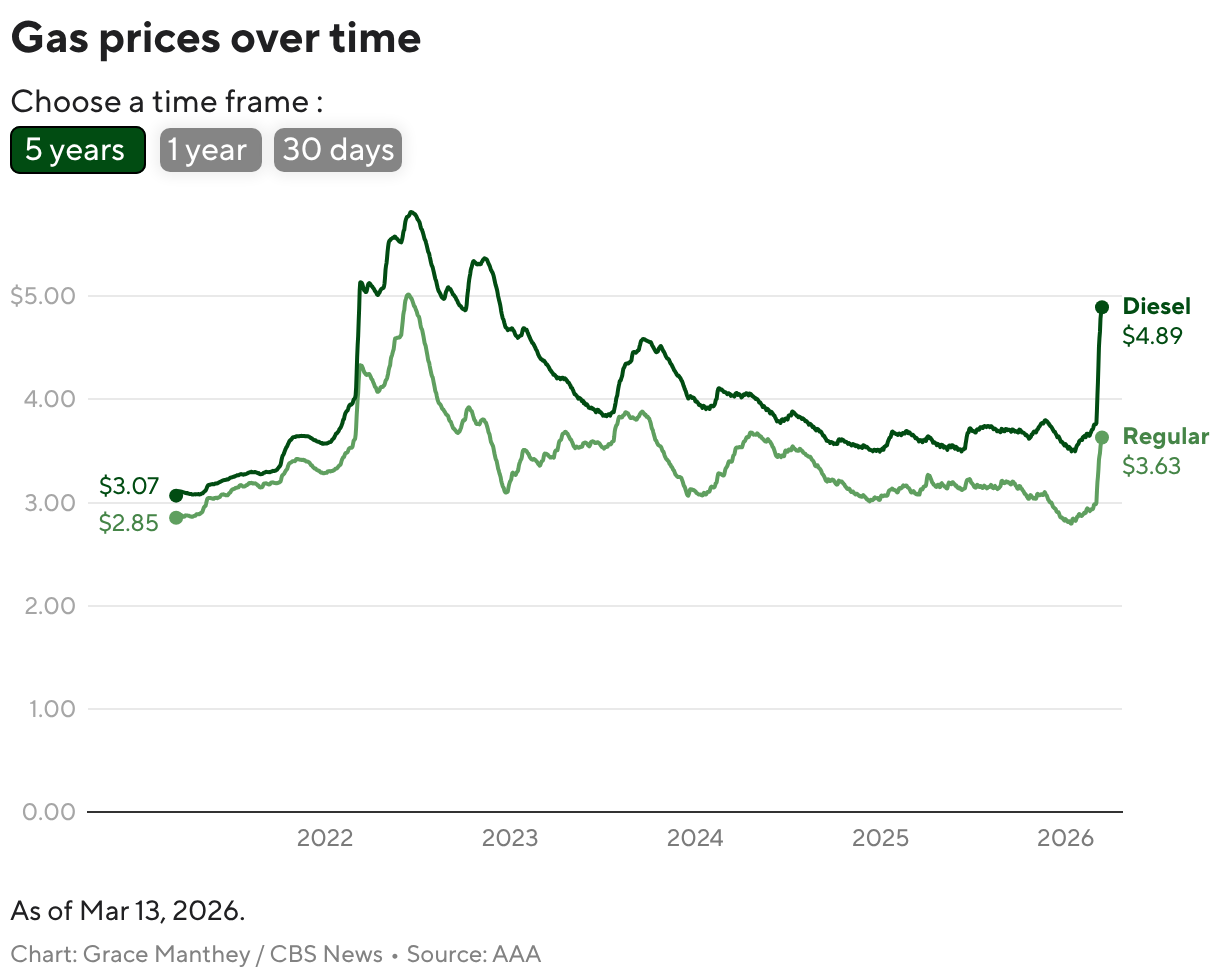
The national average gas price as of March 20 had jumped to $3.92 per gallon, up 29 cents from a week ago and nearly $1 a gallon from February 20, according to AAA.
“Until we see a meaningful resumption of oil flows through the Strait of Hormuz, upward pressure on fuel prices is likely to persist,” Patrick De Haan, head of petroleum analysis at GasBuddy, said in a report. “At the same time, seasonal forces are beginning to intensify as several regions complete the transition to summer gasoline, creating a double headwind that could continue driving pump prices higher in the weeks ahead.”
For now, oil prices remain short of their record highs. That came in July 2008, when both Brent and West Texas Intermediate, the U.S. benchmark, reached around $145 per barrel, or about $215 a barrel on an inflation-adjusted basis, according to data from FactSet.
Over the long term, some experts said Iran could struggle to indefinitely throttle ship traffic through the Strait of Hormuz as the U.S. and Israel degrade the country’s navy and other military capabilities. Blocking Iranian oil from being exported to markets overseas would also badly damage the company’s fragile economy, experts note.
To address such concerns, President Trump on March 3 said the U.S. International Development Finance Corporation would provide insurance to all ships passing through the Persian Gulf. Mr. Trump also said the U.S. Navy would escort tankers through the Strait of Hormuz, if necessary.
What has President Trump said about the Strait of Hormuz and oil?
In a phone interview with CBS News on Monday, March 9, Mr. Trump said the United States “could do a lot” about the strait and threatened Iran if it inhibits the waterway. The president also said, “The war is very complete, pretty much.”
“They’ve shot everything they have to shoot, and they better not try anything cute or it’s going to be the end of that country. … If they do anything bad, that would be the end of Iran and you’d never hear the name again,” he said.
The president also said on March 9 that the strait was open and claimed ships had been entering the strait, but said he was still “thinking about taking it over.”
Speaking later that day to reporters at his Miami-area golf club, Mr. Trump said he doesn’t expect the war to end next week, but “soon.”
The president said Iran will get hit “at a much, much harder level” if Iran does anything to stop the world’s oil supply, saying: “I will not allow a terrorist regime to hold the world hostage and attempt to stop the globe’s oil supply.”
Mr. Trump reiterated that the U.S. is offering political risk insurance to any tankers in the Persian Gulf, and the U.S. could escort tankers through the strait if needed.
“If they do anything, the price will be incalculable,” the president said of potential Iranian operations against oil tankers.
Are there alternatives to the Strait of Hormuz?
Oil that ordinarily would pass through the Strait of Hormuz by ship could be exported via other routes.
Those include the East-West Pipeline, also known as Petroline, a nearly 750-mile-long pipeline in Saudi Arabia that delivers oil to ports on the Red Sea. Shipments could also be diverted to the Abu Dhabi Crude Oil Pipeline, a roughly 400-mile pipeline in the United Arab Emirates that transports oil to a facility on the Gulf of Oman.
Yet such alternative routes can only accommodate a fraction of the volume of oil that ordinarily passes through the Strait of Hormuz on a daily basis, according to experts.
David Oxley, chief climate and commodities economist at Capital Economics, said in a note to investors: “From an energy market perspective, the impact on energy flows from the Middle East will be dictated by two key variables: a) how long the Strait of Hormuz remains closed, and; b) the extent to which potential damage to energy infrastructure in the region constrains energy exports in the future, even when/if shipping through the strait resumes.”